Skip to content

Your child may have plenty to say, even if they aren’t saying many words yet. Maybe they point to what they want, bring you a favorite toy, make sounds, or pull you toward something interesting. You may understand what they mean, but still wonder how you can help them communicate more clearly.
If you’ve been looking for ways to support speech development at home, you don’t need to turn your home into a classroom. Everyday routines, play, books, and simple conversations can create meaningful opportunities for your child to communicate.
At The N.A.E.T. Clinic, we’ve spent more than 40 years working with families and children with a range of health and developmental concerns. One lesson we’ve seen repeatedly is that every child communicates differently. The goal isn’t to pressure a child into speaking. It’s to create more opportunities for connection, understanding, and communication.
What Does Speech Development Really Involve?
Speech is only one part of communication.
Before children use clear words, they may communicate by pointing, reaching, making sounds, using facial expressions, bringing you an object, or showing you what they want. Understanding what other people say is also an important part of communication.
This means parents can support language skills even when their child isn’t saying many words yet.
Watch for moments when your child:
- Points toward something they want.
- Makes a sound to get your attention.
- Copies an action or sound.
- Responds to a familiar word.
- Brings you a toy or book.
- Uses gestures or facial expressions.
- Tries to imitate a word.
These attempts matter. Communication is about sharing meaning, not simply counting how many words a child can say.
Start With What Your Child Already Enjoys
You don’t need special equipment or complicated exercises to encourage communication. Start with something your child already loves.
If your child enjoys cars, sit beside them and talk about the cars they are pushing. If they like blocks, describe what they’re building. If animals are their favorite, make animal sounds together and name them.
Follow their interest instead of constantly changing the activity. For example, if your child pushes a car across the floor, you might say:
“Car.”
Then add a little more:
“Red car.”
Later, you could expand it:
“The red car is going fast.”
Your child doesn’t have to repeat each phrase. Hearing language connected to something they are already interested in gives words meaning.
This is one of the simplest ways to support speech development at home because communication becomes part of something your child already enjoys.
Talk During Everyday Moments
Some of the best opportunities to communicate are already built into your daily routine.
You can talk while:
- Getting dressed
- Preparing meals
- Taking a bath
- Putting toys away
- Shopping for groceries
- Walking outside
- Getting ready for bed
You don’t need to ask questions constantly. Instead, describe what you and your child are doing.
During breakfast, you might say, “Here’s your banana.” While getting dressed, name the shirt, shoes, and socks. During cleanup, say, “Blocks away.”
These short, repeated interactions help children hear how words are used in everyday situations.
Parents who want to improve speech at home sometimes feel they need to schedule special practice sessions. But communication can happen throughout the day. A few natural words during breakfast or play can be just as meaningful as a planned activity when they fit your child’s attention and interests.

Give Your Child a Reason to Communicate
Sometimes parents help so quickly that their child doesn’t get a chance to communicate. If your child reaches toward a favorite toy, for example, you can pause before handing it over. Hold the toy where they can see it and say, “Car?” Then give them time.
Your child might respond with:
- A sound
- A gesture
- A point
- A look
- A word
- An attempt at a word
Each of these can be an opportunity to respond.
Try not to turn these moments into tests. You don’t need to repeatedly say, “Say car” or ask your child to repeat the same word.
Instead, respond positively to their attempt and model the word naturally.
The goal is to show your child that communication works. When they make an attempt and you respond, they learn that their actions, sounds, gestures, and words can help them connect with another person.
Follow Your Child's Lead
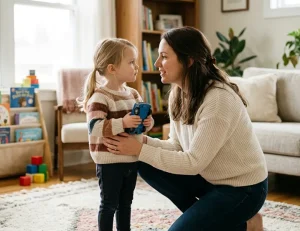
One of the easiest ways to make communication more natural is to follow what already has your child’s attention. Get down beside them. Watch what they’re doing. Join their activity. Then add a few simple words.
If they’re stacking blocks, you might say:
“Up.”
When the tower falls:
“Oh! Down.”
If they’re feeding a doll:
“Baby eating.”
If they’re pushing a truck:
“Truck goes.”
Short phrases connected to what your child is actually experiencing can be easier to understand than long explanations.
Following your child’s lead also gives you useful information. You begin to see which activities hold their attention, what makes them excited, and which forms of communication they naturally use.
Make Books and Songs Interactive
Reading a book doesn’t have to mean sitting still and listening to every page. Choose books with familiar pictures and let your child participate. Point to a dog and say “dog.” Pause before turning the page. Let your child point to a favorite picture. If they make a sound, respond to it.
Songs can work in much the same way. Familiar songs give children opportunities to hear repeated sounds, words, and phrases.
Simple speech activities for toddlers can include:
- Naming pictures in a favorite book
- Making animal sounds
- Singing familiar songs
- Copying simple actions
- Taking turns making sounds
- Pointing to familiar objects
- Finding objects you name
The activity doesn’t need to last a long time. If your child loses interest, follow their lead and try again later.
Give Your Child Time to Respond
Adults often speak faster than children can process.
You may ask a question, wait for a second, and then answer it yourself because the silence feels uncomfortable. But some children need more time to understand what you’ve said and decide how they want to respond.
Try asking one simple question and pausing.
Give your child time to respond. Watch their face and body language. They may answer with a sound, gesture, point, expression, or word.
For example, instead of immediately saying:
“Do you want juice? Yes, you want juice.”
Try:
“Do you want juice?”
Then wait.
A pause doesn’t mean nothing is happening. Your child may be listening, processing, and deciding how to communicate.

What If My Child Is Still Struggling to Communicate?
Home activities can create valuable opportunities for communication, but parents shouldn’t feel responsible for solving every concern on their own. If you’re worried about your child’s communication, start by observing what happens during everyday situations.
Ask yourself:
- What does my child understand?
- How do they show me what they want?
- Do they imitate sounds or actions?
- Are they gaining new communication skills?
- Have they lost skills they previously had?
- When do they communicate most easily?
Writing down these observations can make conversations with a healthcare professional more useful.
If concerns continue, seeking appropriate speech delay help can help you better understand your child’s individual needs and determine whether further evaluation or support may be appropriate.
The N.A.E.T. Clinic also has an educational resource specifically addressing the question parents often ask: Why Isn’t My Child Talking? This can be a useful next step for parents who want to understand communication concerns from a broader perspective.
What Our Experience Has Taught Us About Communication
Over more than four decades of working with families, we’ve learned that communication progress doesn’t always follow a straight line.
A child may communicate more during one activity than another. They may use a new word one day and rely more on gestures the next. Parents are often the first people to notice these small changes because they see their child across different situations every day.
Our published patient stories also show how individual communication journeys can be. One family describes their child’s progression from very limited speech and communication toward using more words and phrases, interacting with others, and participating more actively at school. These are individual experiences, not guarantees of what another child will experience, but they illustrate why each family’s observations and circumstances matter.
Our collection of published case studies and patient experiences gives parents an opportunity to learn from the experiences shared by other families.
For parents interested in the research behind our approach, we also provide our published autism research study. The study reports communication-related outcomes among the children included in the research, but parents should understand that findings from a specific study do not predict an individual child’s outcome.
Small Moments Can Create Big Opportunities
Supporting speech development at home doesn’t mean turning every part of the day into speech practice. It can be as simple as talking while making breakfast, waiting for your child to respond during play, sharing a book before bedtime, or following their excitement when they discover something interesting.
You don’t need to make every interaction educational.
Instead, focus on being present, noticing your child’s attempts to communicate, and giving them opportunities to participate.
The question isn’t always:
“How can I make my child talk?”
A more helpful question may be:
“How can I create more opportunities for my child to communicate with me?”
That shift can take some of the pressure away and put the focus back on connection.
When Should Parents Seek Professional Guidance?
If you continue to have concerns about your child’s communication, it’s reasonable to seek professional guidance rather than relying only on information you find online. Consider discussing your concerns if your child has ongoing difficulty communicating needs, understanding language, interacting with others, or has lost communication skills they previously had.
A qualified healthcare professional can consider your child’s developmental history, communication style, and broader needs when discussing appropriate next steps.
You don’t have to wait until you understand exactly what is happening before asking questions.

Every Conversation Is an Opportunity to Connect
There is no single activity that will make every child begin speaking. What works for one child may not work in exactly the same way for another. What parents can do is create an environment where communication is noticed, welcomed, and encouraged.
Talk about what your child enjoys. Listen to their attempts. Give them time. Play together. Read together. Follow their interests.
And when concerns continue, ask for guidance.
The N.A.E.T. Clinic also provides educational resources and physician discussions that families can explore as they continue learning about communication and developmental concerns.
Your child’s communication journey may look different from another child’s. That doesn’t mean there are no opportunities for growth. With patience, informed support, and a better understanding of your child’s individual needs, everyday moments can become meaningful opportunities to connect.
FAQs
Start with activities your child already enjoys. Talk about what they’re doing, use simple language, pause to give them time to respond, and acknowledge gestures, sounds, and words as communication attempts. The goal is to make communication natural rather than turning every interaction into a lesson.
Reading picture books, singing familiar songs, playing with favorite toys, naming everyday objects, making animal sounds, and taking turns during play can all create opportunities for communication. Choose activities your child enjoys so interaction feels natural and engaging.
Constant correction can make communication feel like a test. Instead, model the correct word naturally. If your child says “ba” for “ball,” you can respond, “Yes, ball!” This gives them a clear example without interrupting the interaction or making them feel pressured.
There is no exact amount of time that works for every child. After asking a simple question or making a comment, give your child enough time to process what you’ve said and respond in their own way. Watch for sounds, gestures, pointing, facial expressions, or words.
Yes. Play creates natural opportunities for communication because children are often highly engaged in activities they enjoy. Follow their interests, take turns, describe what is happening, and use simple words connected to the activity.
If you have ongoing concerns about your child’s communication, understanding, or development, consider discussing them with a qualified healthcare professional. Sharing specific observations about what your child can and cannot communicate can make that conversation more useful.
Related Articles



Take the Next Step
If you’re searching for autism treatment near me, the next step is understanding what’s happening beneath the surface.