Skip to content

One of the happiest moments for any parent is hearing their child say their first word. Whether it’s “Mama,” “Dada,” or a favorite toy’s name, those early words become memories families cherish forever.
But what happens when those words don’t come?
Perhaps your toddler understands everything you say but rarely speaks. Maybe they’ve learned a few words but haven’t added any new ones for months. Or perhaps you’re watching other children their age chatter away while your child mostly communicates through gestures or sounds.
These moments often leave parents with more questions than answers.
- Will they catch up on their own?
- What are the real speech delay causes?
The truth is that speech develops differently for every child. Some children begin talking earlier than expected, while others need more time or additional support. Understanding the possible speech delay causes can help parents know what to observe, when to seek guidance, and how to support their child’s communication journey with confidence.
Every Child Learns to Speak at Their Own Pace
Before exploring the possible reasons behind delayed speech, it’s important to remember that development isn’t a race.
Children don’t all reach language milestones on the exact same timeline. Some begin speaking in full sentences before their second birthday, while others take a slower path but eventually develop strong communication skills.
Speech development depends on several abilities working together, including:
- Hearing and recognizing sounds
- Understanding language
- Remembering words
- Coordinating the muscles used for speaking
- Paying attention during conversations
- Social interaction with caregivers
If one or more of these areas develops differently, speech may also develop at a different pace.
That’s why healthcare professionals don’t look only at the number of words a child says. They also observe how the child communicates through gestures, facial expressions, play, understanding, and interaction with others.
Looking Beyond Words: What Parents Often Notice First
Interestingly, delayed speech rarely begins with parents counting words.
Instead, families usually notice small everyday moments that feel different.
You might notice your child:
- Points instead of speaking.
- Gets frustrated because they can’t express what they want.
- Uses the same sounds repeatedly without adding new words.
- Doesn’t imitate words or simple sounds.
- Understands instructions but rarely responds verbally.
- Prefers pulling your hand toward an object instead of asking for it.
These observations don’t automatically indicate a developmental condition. They simply provide valuable clues that can help healthcare professionals understand how your child’s communication skills are developing.
Parents are often the first to notice these subtle differences, and those observations play an important role during developmental evaluations.
What Happens During Speech Development?
Learning to speak is far more complex than many people realize.
Long before children say their first words, their brains are already building the foundations for language. Every conversation, song, bedtime story, and playful interaction helps strengthen these connections.
Speech development involves several stages:
Listening Comes First
Babies begin learning language by listening to voices around them. They gradually recognize familiar sounds, words, and speech patterns.
Understanding Before Speaking
Many children understand hundreds of words before they can say them. This stage is completely normal and forms an important part of language development.
Practicing Sounds
Babbling, repeating syllables, and experimenting with different sounds help children strengthen the muscles needed for speech.
Connecting Words With Meaning
As children interact with the people around them, they begin associating words with objects, actions, emotions, and experiences.
When one or more parts of this process develop differently, parents may begin noticing delayed speech in children.
The Most Common Speech Delay Causes
There isn’t one single explanation for speech delay. Instead, healthcare professionals consider several possible factors before understanding why a child may be speaking later than expected.
Hearing Differences
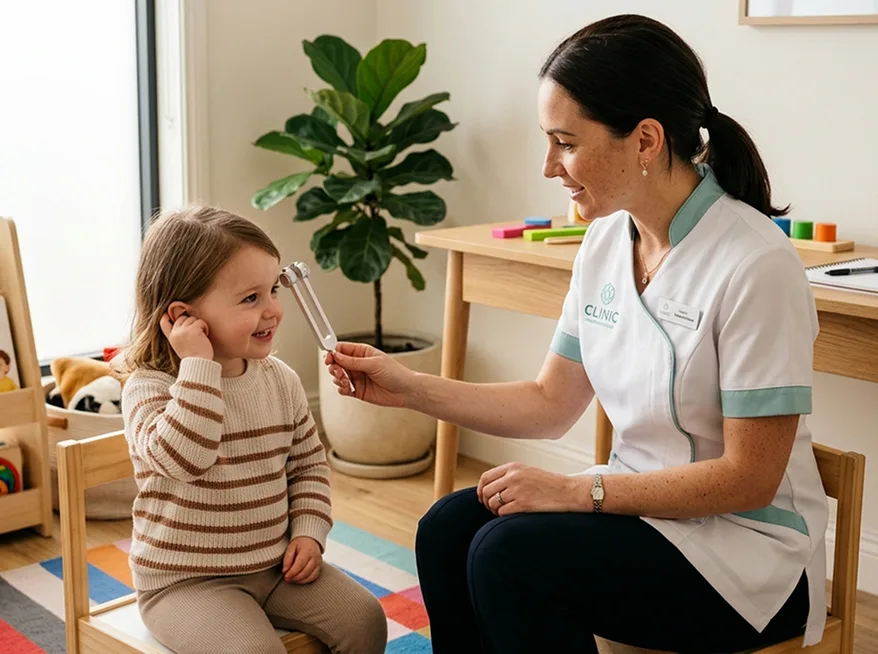
One of the first things doctors often evaluate is hearing.
Children learn to speak by listening to language every day. If hearing is reduced because of hearing loss or frequent ear infections, it can become more difficult for children to hear words clearly and imitate them.
Some signs include:
- Limited response to sounds
- Frequently saying “huh?”
- Not reacting consistently when their name is called
- Repeated ear infections
Even mild hearing difficulties can affect language development, which is why hearing assessments are often recommended when speech delays are identified.
Developmental Differences
Some children simply develop communication skills more slowly than others.
They may:
- Understand language well.
- Follow simple directions.
- Enjoy playing with others.
- Need extra time before using spoken words.
These children are sometimes called “late talkers.” While many eventually catch up, others may benefit from additional evaluation to better understand their developmental needs.
Because every child is different, monitoring progress over time is often just as important as evaluating where they are today.
When Speech Delay Is Part of a Bigger Picture
Sometimes speech delay occurs on its own. In other situations, it may appear alongside other developmental or medical concerns.
Healthcare professionals look at many aspects of development together, including:
- Social interaction
- Play skills
- Motor development
- Attention
- Learning
- Sensory responses
- Overall health
For example, some children experiencing autism speech delay may also communicate differently through eye contact, gestures, pretend play, or social interaction. However, speech delay alone does not mean a child has autism.
Similarly, other children may experience speech delays because of neurological conditions, genetic differences, muscle coordination challenges, or broader developmental delays.
This is why a comprehensive evaluation is so valuable. Rather than focusing on one symptom, healthcare professionals work to understand the child’s overall development before making recommendations.

Why Some Toddlers Experience Speech Delays While Others Don't
One question parents frequently ask is why one child seems to talk nonstop while another of the same age is still using only a handful of words.
The answer isn’t always simple.
Toddler speech delay can result from one factor or a combination of several. Every child develops within the context of their own genetics, environment, health, and life experiences. That’s why healthcare professionals avoid assuming there is a single explanation for delayed communication.
Some factors that may influence early language development include:
- Frequent ear infections that affect hearing.
- Premature birth or low birth weight.
- Developmental differences.
- Neurological conditions.
- Limited opportunities for social communication.
- Oral motor difficulties that affect speech production.
Rather than comparing children with one another, it’s more helpful to compare a child with their own developmental progress over time. Small improvements from month to month often provide valuable insight into how communication skills are evolving.
A Family's Journey: Finding Hope in Small Milestones
Every child’s journey is different, but many families share similar concerns when they first seek answers. One mother described how her son struggled to sit still, communicate his needs, and often became frustrated because he couldn’t express himself.
Over time, she was encouraged by small but meaningful changes, including improved attention, better participation in daily activities, and using more words to communicate. She also noticed that everyday routines became less stressful for the entire family.
You can watch her story to learn more about their experience. While every child’s journey is unique and results may vary, stories like hers remind us of the importance of seeking guidance early and celebrating every step forward.
Communication Begins Long Before the First Word
Parents sometimes focus only on spoken words, but communication starts much earlier.
Before children begin talking, they learn to communicate in many different ways.
For example, they may:
- Smile when they see familiar faces.
- Point toward something they want.
- Wave goodbye.
- Clap during songs.
- Bring toys to share with a parent.
- Use facial expressions to show excitement or frustration.
These early interactions are important building blocks for speech and language.
When evaluating causes of speech delay, healthcare professionals often look at these non-verbal communication skills alongside spoken language. A child who communicates confidently through gestures may have different developmental needs than a child who struggles with both verbal and non verbal communication.
Looking at the complete communication picture provides a more accurate understanding than counting spoken words alone.

What We've Learned From Working With Families for More Than 40 Years
During more than four decades of caring for children, we’ve met families from many different backgrounds, but their first question is often the same:
We’ve found that speech delay is often only one part of a child’s story. Parents frequently tell us about recurring allergies, digestive discomfort, picky eating, eczema, frequent illnesses, or sensory sensitivities alongside communication challenges.
While these experiences don’t necessarily share the same cause, they remind us that understanding the whole child helps us ask better questions and develop a more complete picture of their health.
Everyday Moments Can Become Powerful Learning Opportunities
The good news is that parents don’t need expensive equipment or formal lessons to encourage language development.
Some of the best opportunities happen during ordinary daily routines.
Talk Through Your Day
Describe what you’re doing while cooking, shopping, or getting dressed.
Simple conversations expose children to new vocabulary naturally.
Read Together Every Day
Books introduce children to new words, ideas, and conversations.
Even ten minutes of reading each day can support language development.
Encourage Turn-Taking
Whether you’re rolling a ball, building blocks, or singing songs, taking turns teaches children how conversations work.
Expand What Your Child Says
If your child says “car,” you might respond with:
“Yes, that’s a big blue car.”
This gently introduces new vocabulary without correcting or pressuring the child.
Celebrate Communication in Every Form
Not every success has to be a spoken sentence.
Pointing, gestures, eye contact, signs, sounds, and attempts to imitate words are all meaningful steps in communication development.
Questions Parents Can Ask Before Their Child's Evaluation
Many families feel unsure about what information healthcare professionals need.
Keeping track of everyday observations can make appointments more productive.
You may find it helpful to note:
- What words does my child use consistently?
- Do they understand simple instructions?
- How do they ask for what they want?
- Do they imitate sounds or words?
- Have I noticed any changes over the past few months?
- Are there any concerns about hearing, feeding, sleep, or behavior?
These observations help create a clearer picture of your child’s development and allow professionals to make more individualized recommendations.
One Child's Journey Doesn't Define Another's
Parents naturally compare milestones.
It’s understandable.
When another child the same age is speaking in full sentences, it’s easy to wonder whether your own child is falling behind.
But communication doesn’t follow one fixed timeline.
Some children begin talking later and quickly catch up.
Others may need additional evaluation and ongoing support.
What matters most isn’t comparing your child with others. It’s understanding their unique strengths, recognizing areas where they may need help, and celebrating every step forward, no matter how small it seems.
Conclusion
Understanding the possible speech delay causes is the first step toward supporting your child’s communication journey. While delayed speech can result from a variety of developmental, hearing, neurological, or environmental factors, early observation and professional guidance can help identify the right path forward.
Every child develops at their own pace, and timely support can make a meaningful difference. If you’d like to learn more about speech development and complementary approaches to care, The NAET Clinic offers educational resources, physician discussions, and published research to help families make informed decisions alongside their healthcare providers.
FAQs
Common speech delay causes include hearing difficulties, developmental differences, neurological conditions, oral motor challenges, and genetic factors. In some children, more than one factor may contribute.
No. While autism speech delay is one possible cause, many children with delayed speech do not have autism. A professional evaluation helps identify the underlying reason.
If your child uses very few words, loses previously learned words, or struggles to understand simple instructions, it’s a good idea to seek a professional evaluation.
Yes. Some children catch up naturally, while others benefit from speech therapy or other supportive interventions based on their individual needs.
Reading together, talking throughout the day, and encouraging everyday conversations can support language development. If concerns continue, consult a qualified healthcare professional.
Related Articles




Take the Next Step
If you’re searching for autism treatment near me, the next step is understanding what’s happening beneath the surface.